
At the helm of artisanal luxury with Chanakya craft atelier

How a craft school at the heart of India’s cosmopolitan Mumbai continues to transform the vocabulary of textile innovation
'Made in India' and the idea of luxury
For over 200 years, India has been renowned for its finest craftsmanship and dyeing techniques. References to exchanges of muslin and the celebration of craft can be traced back to 6th-century poems, highlighting the enduring importance of these traditions. Throughout millennia, India has consistently been a focal point for craft, gaining recognition since the 8th century. The rich tapestry of Indian heritage, embedded in the DNA of its people, has been blessed with knowledge passed down through generations.
With global industrialization, there was a perceptible shift in consumer behaviour, relegating traditional craft to a secondary role. Also, the global perception of luxury was dominated by Western aesthetics, overshadowing the immense potential and sophistication of Indian subcontinents’ artisanship. Additionally, there was a lack of awareness and exposure to the unique techniques and exceptional-quality materials that India offers. Misconceptions about the quality and standards of Indian craftsmanship further contributed to this reluctance.
What has changed now is a growing appreciation for authenticity and the stories behind luxury products. Consumers are increasingly valuing the intricate handwork, sustainable practices, and cultural richness that Indian artisans bring to the table. The idea of luxury has indeed evolved. It is no longer solely about opulence and exclusivity but also about uniqueness, sustainability, and cultural significance.
Global fashion houses are increasingly acknowledging the importance of safeguarding these traditions. The preservation of craft has become a crucial aspect of their communication and collective celebration. This recognition not only contributes to the protection of our collective identity but also fosters a deeper understanding of the subcontinent’s traditions among people around the world.
The Chanakya Foundation and cultural preservation
As a child, I was inspired by my parents’ spiritual values and deep appreciation for craft; our home was filled with conversation around art, culture and India’s artisanal legacy. When my father founded Chanakya in the early eighties, his vision was to share India’s finest craftsmanship with the world, he did so by bringing together 13th & 14th generation master craftsmen to Mumbai to form a craft collective. Recognising a compelling need to address social, economic, and environmental challenges, we established the Chanakya Foundation in 2015. The foundation is committed to fostering cultural sustainability and holistic advancement through education, skill development, and dedicated efforts to preserve India's rich artisanal heritage while promoting the arts.
As I delved deeper into the world of indigenous crafts, I understood the critical role it plays in cultural sustainability. I have witnessed how the preservation of these age-old practices has not only ensured the survival of exquisite art forms but also served as a powerful tool for community cohesion and the transmission of cultural knowledge across generations. Cultural sustainability is thus a response to a shift in our values that seeks to recognise the importance of diversity, inclusion, representation, communities and their representative material cultures, as well as the role that craftsmanship plays in expressing traditional culture.
As part of the preservation exercise, Chanakya innovates upon traditional craft techniques. An example is the chand jaal, a delicate lace that features coiled threads forming an intricate mesh made of pure silver, historically patronised by the Mughals. The final embroidery forms a self-standing fragile lace that was previously extinct but is now revived. Similarly, Raffia is a natural fibre and is ingeniously woven into contemporary dresses, trousers, jackets, skirts and pants and indigenous hand embroidery techniques such as lace-making, applique and quilting are revisited in a contemporary context. So, one can say that, through a careful balance of preserving heritage and innovating responsibly, we ensure that a craft form remains relevant and captivating in an ever-evolving world. In addition to preserving traditional techniques, Chanakya actively engages in research and documentation of craft resulting in an extensive collection of over 10,000 archives, each marked by their immense diversity.
Art meets craft at the Venice biennale representing South Asia
Our artistic collaborations pave the way for artists and artisans to work collaboratively and blur the boundaries between art and craft. Collaborations between artists, artisans, and institutions like Chanakya are crucial for several reasons: they foster cross-cultural dialogues and exchange of ideas.
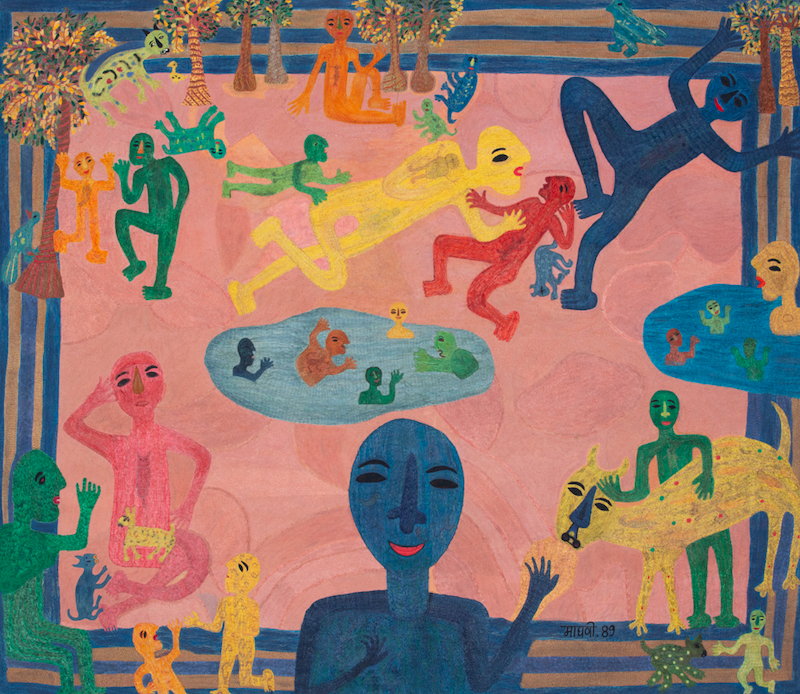
Our collaboration with Madhvi Parekh and Madhu Parekh for the Cosmic Garden honours the pluralistic beauty of India’s cultural heritage, featuring paintings and sculptures and the evolution of their practice into a third interdisciplinary medium — hand-embroidery — presented through crafted works and sculptures created by the Chanakya School of Craft. This carefully curated series of works embraces a multidisciplinary approach, dismantling hierarchies between the arts, roles, and genres. The project seeks to re-evaluate the mutual relationship between women and embroidery, transcending the confines of domesticity by bringing hand embroidery into the public sphere.
Art in 2024 is a multifaceted dialogue that reflects the complexities of our globalised world. It is about storytelling, cultural preservation, and innovation. In this context, the representation of South Asian artists at a prestigious platform like the Venice Biennale is at a turning point in representation. It ensures that the rich tapestry of South Asian culture, history, and contemporary experiences are part of the global art conversation.
Design process balances between traditional and modern
Our artistic collaborations are an exercise in imagination, and a creative exchange with artists, all driven by a shared vision for craftsmanship. We have worked with celebrated stalwart artists like Isabella Ducrot, Marta Roberti, Olesia Trofymenko, Manu & Madhvi Parekh, and Judy Chicago to pave the way for the master artisans of the Chanakya ateliers and the graduated women of the Chanakya School of Craft to work collaboratively to create a completely unique creative expression. The result becomes a true conceptual act. These unique artworks truly represent the coming together of values, community, cultures and traditions.
We approach the collaborations spontaneously and follow a multidisciplinary craft approach to embroidering the works with small needle zardozi techniques using shaded silk threads, organic linen jute, and cotton threads. We work to ensure that the colours of the hand embroideries remain true and vivid, just like the ones in the paintings. Each stakeholder has an integral role to play in this creative exchange.
One of the most interesting aspects of this immersive experience is when we work to alter the scale of the original artwork into monumental craft, while maintaining balance, proportion and depth with utmost precision. The idea of altering the scale of the works into a monumental size was to allow viewers an all-immersive experience that explores contemporary craft, and the shared language between art and craft, celebrating the interconnectedness between these two disciplines. Through this deeply rewarding process, we celebrate the multi-dimensional forms of Indian art and the shared language between art and craft.
Values and Vision for Chanakya school of craft
Established in 2016, Chanakya School of Craft is a non-profit school and foundation dedicated to craft, culture and creating new autonomy for women. The school has educated over 1200 women to-date, teaching over 300 hand embroidery, hand weaving and macramé techniques through a holistic curriculum anchored through the voices and lives of historical female figures like Coco Chanel, Frieda Kahlo and Sarojini Naidu.
Historically, craft is passed down from father to son in India. Our school is unique in that it not only teaches the intricacies of hand embroidery, but the curriculum exposes our female students to the facets of culture and design. Training women in colour theory, semiotics and art history, in a simple and engaging manner, helps the students embrace craft in all its aspects.
The goal for the school is to create a platform of multi-dimensional learning, focused on the arts and crafts while providing equal opportunity to an often ignored backbone of our communities: women. It is truly an incredible feat for our female students to work collectively with celebrated artists like Judy Chicago, Eva Jospin, Manu Parekh, Madhvi Parekh, Olesia Trofymenko and Mickalene Thomas.
India to Italy, embracing maximalist aesthetics and cross-cultural collaboration
The cross-cultural collaboration between India and Italy, particularly through our work at the atelier in Bologna, has been profoundly enriching. Both cultures share a deep appreciation for art history, architectural splendour, and a deep appreciation for artisanal legacies, which seamlessly blend into our designs. This fusion has allowed us to create unique garments that resonate globally, celebrating the intricate hand embroidery and textile traditions of India alongside that of Italy. Our commitment to high-quality craftsmanship and cultural storytelling differentiates our brand and also aligns with sustainable and ethical fashion practices, making our creations both beautiful and responsible.