
Musings of a Musafir with a Caravan at a Sarai
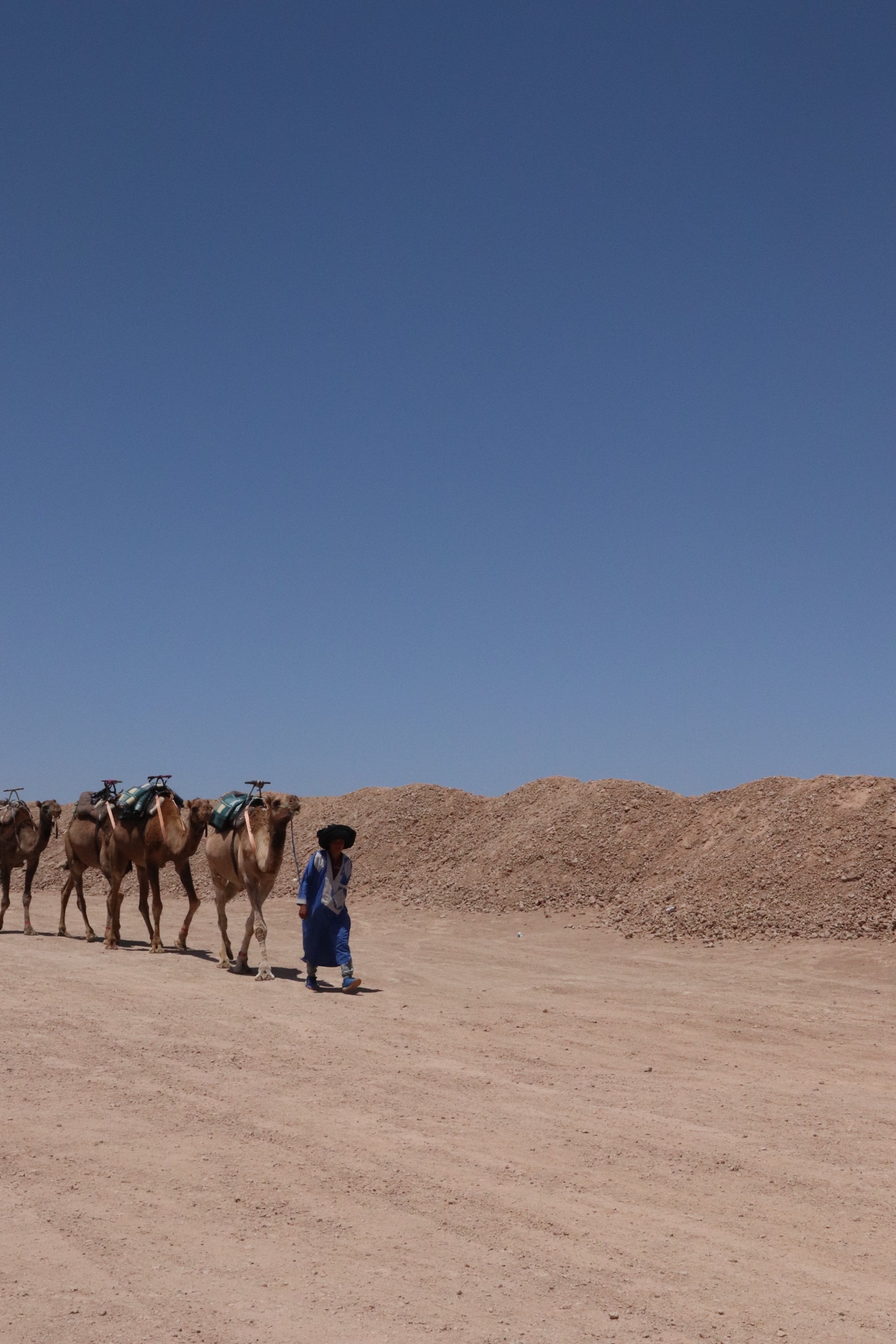
As I see the dust of the sandstorm
settle in the distance,
the billowing breeze brushed against my skin,
here at the sarai—
lulling me to sleep.
I sit, seeking rest against the walls,
for we spent all our day looking for water
and tending to our tired herd of camels.
My fellow traders and merchants are asleep
Yet, I am wide awake.
I’ve been longing
to write to you.
A crumbling piece of paper,
a quill and a pot of ink that I brought,
and kept safe and close, all along—
just for you.
If one of us changes their mind
and turns back,
I shall hand over this letter
to carry my words safely to you.
My pensive mind wanders
and evokes visions of the streets where we lived—
Reminiscing about the times we spent
chatting with the neighbours,
drinking tea and breaking bread—
dreaming of seeing the world together.
I often think,
how you have yearned
for us to be in each other’s company
and to see the world
through my eyes.
I wait for the day
when you and I would lie
under the Hindustani razai,
waking up to the warmth of the wintry morning sun,
away from the world’s conundrums,
away from the treacherous journeys
through the endless desert sands.
Besides the flickering light
of the burning candle,
I shall narrate fables
from the caravan journeys
and remember my days
at the Persian bazaars
and the royal palace,
how I prayed for us
at the mosque with towering minarets,
the exquisite finery the rulers wore,
the mewas we were gifted
and how we cunningly hid
precious emeralds, sapphires and rubies
in our robes.
Do not be anxious,
when I tell you about the marauding bandits—
who nearly robbed us,
of all our belongings.
We fought the raiders with great strength
but were left wounded and helpless.
How I craved for you to be there,
that night,
when all hope seemed empty and hollow.
I am counting the days
to the sweet moment when I’ll board the ship back
and return to you.
We’ll be lost in an eternal embrace,
forgetting our time apart—
as if it never existed at all.
I often wonder
if there exists something,
sincerer than our love?
And,
If there’s anything grander
than the desire to travel?
If there is,
then I hope to find it soon
so it can take me back to you.
I am certain,
that it would help us weave
a new story in our lives,
when we’ll be rebuilding
a world of our own—
a place that we can call home.
***
ACT ONE
If all of life is a stage, then travelling is how we raise the curtains to discover the play. Learning about diverse people, their objects, landscapes, smells and textures is an enchanting experience that leaves us overjoyed, surprised and anxious, all at once. When the wanderings come to a halt, we are left wishing for more. It is in our very nature to revisit the inquisitiveness that takes us to unknown places, the delight that each step of travel holds and the hope of finding a sense of pleasure even in uncertain times.
The many legacies and offerings that history has bestowed upon us—archaeological finds, paintings, travelogues, manuscripts and historical accounts compiled by travellers and researchers—narrate how the movement of people and goods was the foundation upon which the contemporary world gained a foothold. Cities and their association with human memory and desire have become subjects of fiction like, in Italo Calvino’s novel, Invisible Cities, where the Venetian traveller Marco Polo paints surreal imagery of cities while narrating his expeditions to Kublai Khan. The expansive influence of travel in our lives touches everything from our creative pursuits to our everyday lives.
Exploring through movement from one place to another is one of the fundamental traits embedded in the human consciousness. The origins of most of our experiences across our cultures today can be traced back to civilizations like the Indus Valley, Egyptian, Greek, Roman and many more. Evidence of trade, arts, scriptures, crafts, and architectural and sanitation systems from those times reflect how development-conscious and aesthetically progressive people were in those days. These primaeval hints of how cultures evolved, locally imbibed and practised across geographical boundaries by different communities help us acknowledge the value of the collective past and its effects on the present that we share now. It is the age-old interest and encouragement for artisanship that lets us experience the warmth of Pashmina shawls, ornately woven Persian carpets, shimmering Indian silk sarees, and appreciate the beauty of vintage jewellery and heritage-inspired homewares and decor.
Amongst the earliest instances of kinship between travel and trade is the Silk Route. This passage for widespread transmission of knowledge, ideas, cultures and religious beliefs established interconnectedness amongst the Eurasian populations and shaped the world economy. It was an incredible and robust network for the exchange of spices, gems, textiles, raw materials, animals and even slaves was set by people notwithstanding the harsh terrains, unfavourable weather and life-threatening conditions. These routes also witnessed the establishment of chaikhanas (tea houses) and coffeehouses that became hubs of intellectual and socio-cultural activity. Here, people also gathered to spend their leisure time. Some of these survive to date alongside contemporary branded coffee chains, epitomizing the universal nature of tea and coffee.
Travellers like Ibn Battuta, following the fulfilment of his pilgrimage to Mecca, decided to travel in the 14th century just to learn about new countries and people, leaving behind crucial literary texts. In the 15th century, Niccolò de’ Conti, an Italian merchant and traveller; Dominico Paes, a Portuguese traveller and Abdul Razak, a Persian Timurid chronicler and Islamic scholar both visited the temple town of Hampi (now a UNESCO Heritage site in India) and described the local socio-cultural milieu, festivities, surrounding built form and bazaars during their time.
Similarities in the architectural patterns among the Mughals, Ottomans and Safavids represent how design elements were borrowed amongst dynasties and how visual language became integral to Islamic Art and other European cultures. Architectural and design principles like balance, symmetry, rhythm, harmony, geometry and emphasis observed in iconic buildings like the Taj Mahal in Agra and the St. Paul’s Cathedral in London tell us how the aesthetics and functionality of the structures were thoughtfully designed in the old days. Palaces like those in Versailles (in France) and Jaipur (in India), mosques in Istanbul, Lahore and Delhi, city darwaazas (gates) and tombs, Mughal baghs (gardens) and an endless list of similar sites are timeless reflections of the grandeur and luxuries once enjoyed by royal families and commoners—many withstood the vagaries of time. Even at a smaller scale, cultural exchange was significantly seen. For instance, shikargah (hunting ground) motifs travelled through a few weavers who had migrated from Persia to Banaras (Varanasi) in India and the local interpretations continue to manifest in Banarasi shikargah silk sarees.
Giving a tangible, lasting form to ideas and practical knowledge throughout the history of material culture brought us closer in our everyday lives. We tend to attach religious and symbolic meanings to objects. And through our unwavering faith in rituals and traditions handed down to us through generations, these meanings became more poignant. Human sustenance continues to be a product of the exchange of commodities and cultures. Patronage in arts, commissioning of manuscripts and emergence of institutions like museums and kitabkhanas (libraries) by eminent rulers in their prime, ensured that we have ample, diverse and legible archives that allow us to construct and widen our understanding of life in the bygone era. The way we click photographs today to record memories is reminsicent of vintage visuals that were upshots of ethnographic documentation. Our ways of chronicling our days might have changed but the human temperament to travel in time remains perpetual.
From the majestic splendour of imperial courts to the tiniest products that we own in our domestic spaces, traces of the past can be found abundantly in the present. The bricks laid in the Great Bath in Mohenjo-Daro, miniature paintings, modes of travel, the food we eat, and garments we wear—have transcended the ages, with each community lending and adapting their interpretations. Iconography, symbols, patterns and design elements help us learn about the culture and aesthetics that prevailed in the past. This is how reliefs and carvings in temple facades in Hampi illustrate the accounts of travellers about local socio-cultural life, indicating the workings of rulers, merchants and artisans. Our ways of eating, drinking, writing, singing, occupations, living spaces, flora and fauna—all were vividly illustrated and documented for posterity.
Such intellectual leanings and scholarly works from any epoch constitute a remarkable resource for historians and conservationists studying a particular time period. Chronologically researching events and their outcomes along the global historical timeline and drawing conclusions has helped expand our horizons and consolidated the knowledge of our ancestry.
Travel has forever remained at the core of our being while we have been navigating through life. It has revolutionized our thinking profoundly and continues to influence us across multiple arenas. The more we travel, the deeper our interactions tend to become. In a world wrought with differences, it establishes inclusive environments to understand diverse perspectives while constantly reminding us of our rich cultural heritage. This issue is the opening act of the story about how we experience, disseminate and preserve our cultural heritage through trade and travel.
*****